
Quick answer: Yes, business cards are still relevant in 2026. QR codes and NFC cards are great, but they depend on working tech, good signal, and a phone that cooperates. A business card never needs to charge, load, or scan twice. The most effective networkers use both, so there’s always a backup plan.
Now here’s the story that proves it.
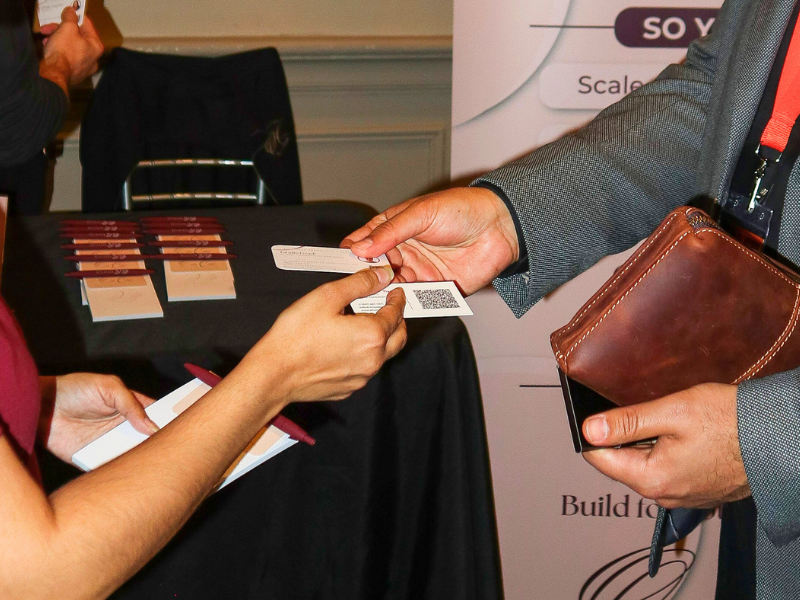
Picture this: we’re exhibiting at a trade show, chatting with a gentleman who stopped by our booth looking for help with his business.
Naturally, we asked what he did.
“What don’t I do?” he replied.
Great line. Zero information. We still had no idea what his business actually was.
We asked for his company name, but between the noise of the event and a dozen conversations happening at once, we couldn’t quite catch it.
Instead of handing over a card, he pulled out his phone and showed us a QR code.
It wouldn’t scan.
He tried again. Still nothing.
Then he smiled and said, “I don’t believe in business cards.”
By the time he walked away, here’s what we were left with:
Not because the technology failed. Because there was no backup plan. That’s the real lesson here, and it’s why this question keeps coming up.
Yes. Not because they’re trendy, and not because they’re traditional. Because they solve a problem that hasn’t gone anywhere: making it incredibly easy for someone to remember you and contact you.
That’s the whole job of a business card. Nothing more.
A well-designed one answers three questions the second someone glances at it:
When people leave a networking event with a stack of cards in their pocket, they don’t have to remember every conversation word for word. They have a tangible reminder sitting right there.
Let’s be clear about something: we love tech. At OnCue, we use QR codes all the time. Systems, automation, anything that makes business easier is our whole thing.
But relying on tech alone assumes everything works perfectly, every time. So what happens if:
None of these are rare. They happen constantly at conferences, trade shows, and community networking events, exactly the moments where a solid first impression actually matters.
This isn’t a choose-one-or-the-other situation. The strongest approach uses paper and digital together.
Your business card can include:
If the QR code works, great, that’s a smooth digital handoff. If it doesn’t, your contact info is still sitting right there in someone’s hand. No frustration, no troubleshooting, no missed opportunity.
A good card doesn’t need to list every single service. It doesn’t need a six-point font crammed into every corner. It needs one thing above all: clarity.
Include:
If someone glances at your card for three seconds, they should immediately know who you are and how to reach you. That’s the bar.
Networking was never about who has the fanciest tech. It’s about reducing friction. Every extra step between meeting someone and actually contacting them is a chance for that connection to slip away.
The easier you make it to follow up, the more likely you’ll actually get that follow-up.
Sometimes that looks like sharing a LinkedIn profile. Sometimes it’s an NFC tap. And sometimes it’s a simple business card someone finds in their blazer pocket three days after the event, at exactly the moment they needed it.
Yes. QR codes and NFC are useful additions, but they depend on working technology. A physical card is a reliable backup that works even when a phone doesn’t cooperate.
Your name, business name, a clear description of what you do, contact info (phone or email), your website, and optionally a QR code for a quick digital link.
Not entirely. The most effective networkers use both, so there’s always a way to connect even if the tech fails.
They remove friction. A card in someone’s hand or pocket is a tangible reminder of who they met, without relying on memory or a working app.
Business cards aren’t outdated. Neither are QR codes, and neither is NFC. The businesses that network best don’t pick a favorite, they use every tool where it actually makes sense.
At the end of the day, networking isn’t about how modern your contact-sharing method looks. It’s about making sure people can actually find you after they’ve met you.
If someone can’t remember your name, your business, or how to reach you, that opportunity is already gone. And that’s one missed connection no business can afford.
Looking for support building systems that make your business easier to run and easier to remember? OnCue Executive Solutions helps service-based entrepreneurs in Brantford and across Ontario bring structure to their operations, so nothing (and no one) slips through the cracks.